You’re at the playground, and you can’t help but notice that other kids your daughter’s age are chattering away while she’s still mostly pointing and grunting. Or maybe you’re at a family gathering, and Aunt Susan asks, for the third time, “He’s not talking yet?” with that concerned look on her face.
Let’s face it: when your toddler isn’t talking on the same timeline as their peers, it’s hard not to worry.
I’ve worked with hundreds of families over the past 25+ years who are in this exact situation. Some of their kids were late talkers who caught up beautifully. Others needed more structured support. The tricky part? In those early months, it can be genuinely difficult to tell which category your child falls into.
So today, I want to walk you through what I’ve learned, both from research and real-world experience, about the difference between a late talker and a speech delay, what to watch for, and most importantly, what you can actually do about it right now.
The Big Question: Late Talker or Speech Delay?
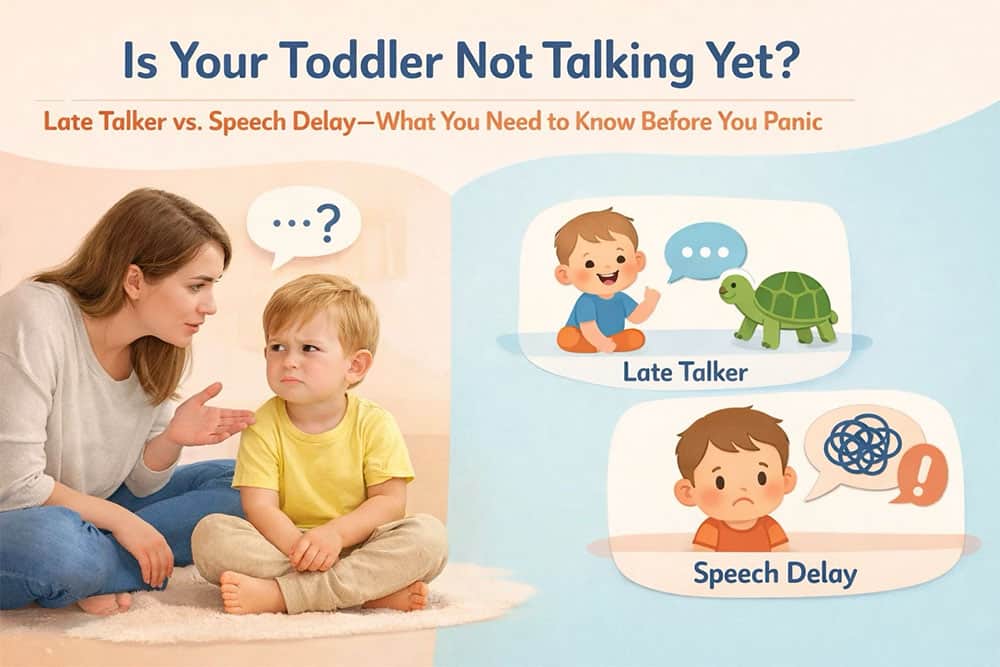
Here’s the key distinction that matters: a late talker is developing language within normal ranges, just at the slower end of the spectrum. A speech delay means your child is falling significantly behind developmental milestones, often with other concerns that suggest an underlying issue.
Think of it this way, late talkers are taking the scenic route to the same destination. Kids with speech delays may need some help finding the road altogether.

What Makes Someone a “Late Talker”?
Late talkers follow the typical developmental sequence, they just move through it more slowly. These kids might have fewer words at 18 months than their peers, but here’s what you’ll typically see:
- They understand what you’re saying (receptive language is strong)
- They use gestures to communicate, pointing, waving, showing you things
- They make good eye contact and engage socially
- They’re trying to communicate, even without a lot of words
- They respond to their name and follow simple instructions
The research suggests that many late talkers, somewhere between 70-80%, catch up to their peers by age 3 without any formal intervention. However, that still leaves 20-30% who don’t, which is why we can’t just adopt a “wait and see” approach for everyone.
When It’s Likely a Speech Delay
A speech delay is different. It means your child isn’t just slow to the party, they’re missing some fundamental building blocks. You might notice:
- Limited comprehension (they’re not understanding age-appropriate language)
- Few or no gestures to communicate their needs
- Difficulty following even simple instructions like “give me the ball”
- Limited engagement or eye contact
- Not responding to their name consistently
- Regression, losing words or skills they previously had
Here’s what I tell parents: trust your gut. If something feels off beyond just “he’s not saying many words yet,” that instinct is worth exploring.
What’s “Normal” Anyway? (And Why That Question Is Complicated)
Parents always want to know: what should my child be doing at this age? I get it. We all want a checklist. But child development isn’t a rigid timeline, it’s more like a broad highway with multiple lanes.

That said, here are some general guideposts:
By 12 months, most children are:
- Saying their first words (“mama,” “dada,” “ball”)
- Babbling with varied sounds
- Responding to their name
- Using gestures like waving or pointing
By 18 months, we typically expect:
- 20-50 words (some kids have way more, some have fewer)
- Beginning to combine two words (“more milk,” “daddy go”)
- Pointing to familiar objects when named
- Following one-step directions
By 24 months, you’ll often see:
- 100+ words
- Two to three-word phrases
- Understanding of simple questions
- Beginning to use pronouns (often incorrectly at first)
Here’s the thing though, and I can’t stress this enough, these are averages. I’ve seen plenty of kids who were a bit behind these markers who turned out just fine. The key is looking at the whole picture, not just word count.
Red Flags That Mean “Call Someone Now”
Some of you might be the parent of a child who isn’t just a little behind, there are some genuine concerns that warrant professional evaluation sooner rather than later.
By 12 months, reach out to your pediatrician or a speech-language pathologist if your child:
- Shows no interest in sounds around them
- Doesn’t respond to their name
- Isn’t babbling or trying to communicate at all
- Has lost skills they previously had
By 18 months, I strongly encourage you to seek guidance if your child:
- Isn’t saying any words
- Doesn’t point, wave, or use gestures to communicate
- Doesn’t seem to understand simple words and instructions
- Prefers not to interact with others
By 24 months, definitely get an evaluation if your child:
- Has fewer than 25 words
- Isn’t combining words at all
- Isn’t trying to imitate words or sounds
- Shows frustration but can’t communicate their needs
Remember, early intervention is incredibly effective. The earlier we can provide support, the better the outcomes. There’s no prize for waiting.

What You Can Do at Home (Starting Today)
While you’re figuring out whether professional help is needed, there are plenty of evidence-based strategies you can use at home. These work whether your child is a late talker who’ll catch up naturally or someone who needs more structured intervention.
Narrate your world. Talk about what you’re doing throughout the day. “I’m pouring milk. The milk is cold. Do you want milk?” It might feel silly at first, but you’re providing language models in context, which is exactly how kids learn.
Get down on their level. Literally. Sit on the floor. Make eye contact. When you’re face-to-face, communication becomes so much richer.
Expand what they say. If your child says “car,” you respond with “Yes, that’s a big red car!” You’re acknowledging their communication and building on it without correcting them.
Create communication opportunities. Put favorite toys just out of reach so they have to ask (verbally or with gestures). Offer choices. Wait expectantly for them to initiate. Give them reasons to communicate. Provide time for them to communicate. However, don’t insist and keep on the until they do. If they do, great! If not, move on.
Read together daily. Point to pictures. Ask simple questions. Let them turn pages. Books are language-rich environments disguised as fun. If your child doesn’t attend to books well, just doing a couple of page. Let them flip through the pages. You don’t have to read the entire book from beginning to end to be beneficial!
Limit screen time. I know this isn’t what you want to hear when you’re exhausted, but passive screen watching doesn’t build language skills the way interactive communication does. It’s not the screen time itself that concerns me, it’s the endless scrolling. So let them watch a video, just try to keep them from scrolling to the next one after only a few seconds.
Respond to all communication attempts. Whether it’s words, gestures, or sounds: respond enthusiastically. You’re reinforcing that communication works. Nonverbal communication needs to be present before we have words!
However, I would encourage you to try not to anticipate every need. If you always give them what they want before they ask, there’s no reason to communicate. It might be hard in the moment when they’re frustrated, but that frustration can actually motivate communication.
When to Seek Professional Help (And What That Looks Like)
If you’re still wondering whether you should reach out to someone, here’s my advice after 25+ years: when in doubt, get evaluated.
A speech-language pathologist can assess your child and determine whether they’re a late talker likely to catch up or someone who needs intervention. Many areas offer free early intervention services for children under 3. Your pediatrician can refer you, or you can often contact your state’s early intervention program directly.
What you might not realize is that speech therapy for toddlers doesn’t look like traditional “therapy” at all. It’s play-based, it’s fun, and it teaches parents strategies to use throughout the day. I conduct sessions where parents walk away with tools they can implement during meals, bath time, and play: not just during our appointment.
The evaluation itself is nothing to fear. The therapist will play with your child, observe how they communicate, and assess their understanding. Then they’ll give you clear recommendations about whether therapy is warranted or if we should monitor and reassess in a few months. Not every therapist has the same skills and there’s nothing wrong with getting a second opinion
The Bottom Line
Look, parenting is full of worry: about milestones, development, whether you’re doing enough. I get it. But here’s what I want you to remember:
Late talkers exist. Some kids just need more time, and that’s okay. But speech delays also exist, and early intervention makes a tremendous difference.
You don’t have to figure this out alone. You don’t have to wait until they’re “supposed to” start talking. And you don’t have to feel guilty about seeking help: in fact, it’s one of the most proactive things you can do as a parent.
If your toddler isn’t talking yet, start by observing the whole picture. Are they trying to communicate? Do they understand you? Are they engaging socially? Use the strategies I’ve shared at home. And if you have concerns: or even just that nagging feeling that something might be off: reach out to a professional.
I’m here to help you figure this out, support your child’s development, and give you the tools you need to help them thrive. Because whether your child is a late talker who needs some extra time or someone who needs more structured support, they deserve the best possible start.
And honestly? So do you.

- Is Your Toddler Not Talking Yet? Late Talker vs. Speech Delay: What You Need to Know Before You Panic - February 23, 2026
- Is Your Toddler Not Talking Yet? Late Talker vs. Speech Delay: What You Need to Know Before You Panic - February 23, 2026
- Is Your Toddler Not Talking Yet? Late Talker vs. Speech Delay: What You Need to Know Before You Panic - February 23, 2026